FPV Motor Series · Motor Fundamentals
Nov 12,2026 | Lumi Manufacturering Technology
Brushed vs. Brushless Motors, Motor Naming Conventions, KV Ratings, Stator Size & Torque
1. Brushed vs. Brushless Motors
FPV drones use two main types of motors: brushed motors and brushless motors.
Modern FPV drones almost exclusively use brushless motors, while brushed motors are mainly found in tiny 1S Whoop drones.
Brushed vs. Brushless Motors Comparison
| Feature | Brushed Motors | Brushless Motors |
| Rotating Component | Coils (rotating armature) | Permanent magnets (rotor bell) |
| Number of Wires | 2 wires | 3 wires + ESC |
| Lifespan | Brush wear; days to weeks | No brushes; can last for years |
| Efficiency | Low, generates more heat | High, generates less heat |
| Power | Low, suitable for micro drones | High, suitable for 1S–12S setups |
| Cost | Lower | Higher |
| Applications | Micro Whoop drones (65–75 mm) | Most FPV drones 2 inches and larger |
2. Internal Structure of a Brushless Motor

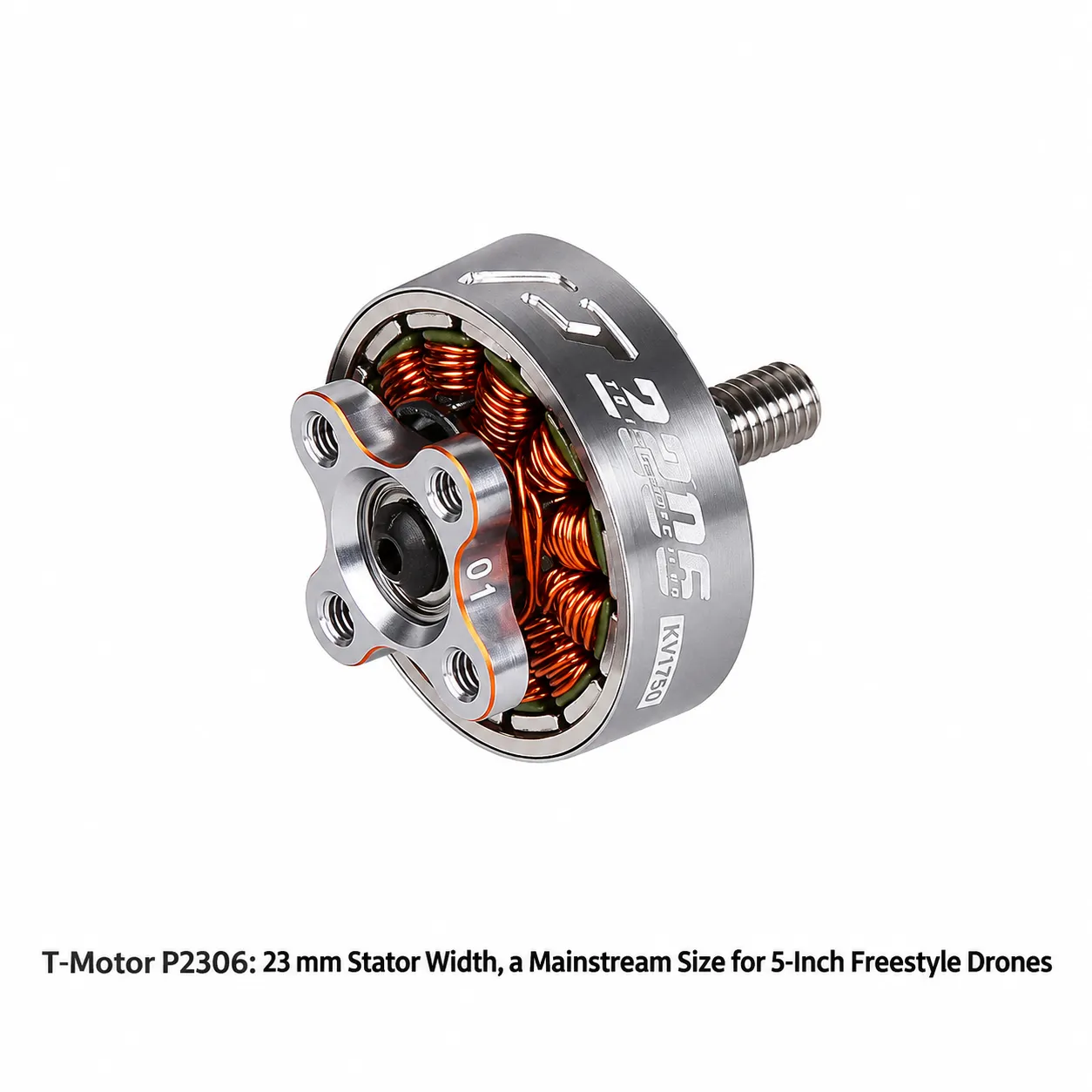
Brushless Motor Breakdown: Stator (Windings) + Motor Bell (Magnets), Showing Stator Width, Stator Height, Bearings, and Shaft.
Brushless Motor Components and Their Functions
| Component | Function |
| Stator | The stationary part that generates a magnetic field when energized. |
| Windings | Copper wire coils wrapped around the stator that generate a magnetic field when current flows through them. |
| Permanent Magnets | Attached to the inside of the motor bell, interacting with the magnetic field to produce rotation. |
| Motor Bell | The outer aluminum housing that protects the magnets and windings. Some designs also help dissipate heat. |
| Shaft | Connects to the motor bell and transmits rotational torque to the propeller. |
| Bearings | Support the rotation of the motor bell and reduce friction. |

3. Motor Naming Conventions
Brushless motor models typically use a four-digit AABB format:
-
AA = Stator width (diameter), measured in mm.
-
BB = Stator height, measured in mm.
Motor Model Stator Dimensions Applications 1103 11 mm diameter × 3 mm height Toothpick drones / 1S Whoop 1404 14 mm diameter × 4 mm height 2-inch / 3-inch micro drones 1806 18 mm diameter × 6 mm height 3-inch / 4-inch FPV drones 2207 22 mm diameter × 7 mm height Mainstream 5-inch freestyle drones 2306 23 mm diameter × 6 mm height 5-inch racing / freestyle drones 2506 25 mm diameter × 6 mm height 6-inch / 7-inch long-range drones Brushed Motor Naming Conventions
Brushed motor naming conventions follow a similar format.
Brushed motor models also typically use four digits. The first two digits indicate the motor diameter (e.g., 60 = 6 mm), while the last two digits indicate the motor height (e.g., 15 = 15 mm).
For example, 7020 = 7 mm diameter × 20 mm height.
4. What Is KV?
KV refers to the motor's no-load rotational speed per volt (RPM/V).
For example, a 2300KV motor powered by a 3S battery (12.6V) has an approximate no-load speed of:
2300 × 12.6 = 28,980 RPM
KV Does NOT Mean Power
A higher KV rating does not necessarily mean greater thrust. KV only indicates how fast the motor spins per volt. KV and torque are two different things — torque is largely influenced by stator size and motor design.
High KV + Small Propeller | Low KV + Large Propeller
This is a basic principle of FPV motor selection.
What Determines KV?
-
Number of Winding Turns: Fewer turns generally result in lower winding resistance and a higher KV rating.
-
Copper Wire Thickness: Thicker wire reduces electrical resistance and can support higher current, but does not directly determine KV.
-
Magnetic Field Strength: Stronger permanent magnets generally result in a lower KV rating, assuming other motor parameters remain unchanged.
The Trade-Offs of High KV
High-KV motors are designed for higher rotational speeds. When paired with an unsuitable propeller, they can draw excessive current and generate excessive heat.
A high-KV motor paired with an oversized propeller may struggle to reach its intended speed, resulting in high current draw and potential motor damage.
Always select the KV rating based on your battery voltage (S rating) and propeller size.
5. Stator Size and Torque
A larger stator generally produces more torque and can drive heavier propellers.
Stator volume can be estimated using the following formula:
\[ V = \pi \times (D/2)^2 \times H \]Where:
-
D = Stator diameter (width)
-
H = Stator height
Wide Stator vs. Tall Stator
Feature Wide Stator (Short & Wide) Tall Stator (Narrow & Tall) Inertia High (more rotational inertia) Low Response Slower, less responsive to speed changes Faster, more responsive to throttle input Heat Dissipation Good (larger surface area) Moderate Bearings Larger bearings, longer service life Smaller bearings Applications Cinewhoop, aerial photography, heavy-lift drones Racing and freestyle FPV drones ![]()
6. Thrust Requirements
Before selecting a motor, calculate the required thrust. The total thrust should be at least twice the aircraft's weight.
Recommended thrust-to-weight ratios:
-
Aerial Photography / Cruising: 3:1–4:1
-
Freestyle: 5:1 or higher
-
Racing: 10:1–14:1
Example:
For a 1 kg drone with four motors:
-
Total thrust requirement: At least 2 kg
-
Number of motors: 4
-
Minimum thrust per motor: 500 g
7. Motor Size Selection Guide
Choose the motor based on your drone frame size (assuming a 4S battery):
Frame Wheelbase Propeller Size Motor Model Recommended KV ≤150 mm 3 inches or smaller 1105–1306 3000KV+ 180 mm 4 inches 1806 / 2204 2600–3000KV 210 mm 5 inches 2205–2208 / 2305–2306 2300–2600KV 250 mm 6 inches 2206–2208 / 2306 2000–2300KV 350 mm 7 inches 2506–2508 1200–1600KV 450 mm 8–10 inches or larger 26XX+ Below 1200KV Classic 5-Inch 4S Motor Setup
One of the most popular and well-proven configurations for 5-inch freestyle FPV drones is:
2207 / 2306 Motor + 2400KV + 5-Inch Propeller + 4S Battery
This combination has been widely tested and proven over years of FPV flying.
For a 6S battery, a lower KV rating of around 1900–2000KV is typically recommended.
8. Summary
In this guide, we've covered the fundamentals of FPV drone motors:
-
Brushed vs. Brushless: Brushless motors are the modern FPV standard, while brushed motors are mainly used in micro Whoop drones.
-
Internal Structure: The main components include the stator (windings), permanent magnets (motor bell), shaft, and bearings.
-
Motor Naming Conventions: AABB represents stator diameter (width) × stator height, measured in millimeters.
-
KV Rating: Indicates the no-load RPM per volt. High KV generally pairs with smaller propellers, while low KV suits larger propellers.
-
Stator Size: Larger stator volume generally provides greater torque. Wide stators offer better heat dissipation, while taller stators can provide faster throttle response.
-
Thrust Requirements: Total thrust should be at least twice the drone's weight. Freestyle typically requires a 5:1 thrust-to-weight ratio, while racing may require 10:1 or higher.
-
Motor Size Selection: A popular 5-inch FPV setup is a 2207 / 2306 motor with 2400KV on 4S.
-
Comment