6201ZZ & 6202ZZ Ceiling Fan Bearing Noise: Is Grease the Real Problem?
Oct 15,2026 | Lumi Manufacturering Technology
Why do some ceiling fans develop unusual bearing noise or wobbling after installation? Could the problem be caused by bearing grease?
For ceiling fan manufacturers and motor suppliers, choosing the right ball bearing is essential for quiet operation, stable rotation, and long service life.
The 6201ZZ and 6202ZZ deep groove ball bearings are commonly considered for compatible fan motor designs. However, even when the bearing dimensions are correct, improper lubrication or internal clearance can affect performance.
1. How Does Bearing Grease Affect Performance?
Bearing grease does much more than reduce friction. It creates a lubricating film between the steel balls and raceways, helping to prevent metal-to-metal contact.
The right grease can provide four important benefits:
-
Lower Noise: Proper lubrication reduces friction-related noise and can help minimize vibration.
-
Longer Bearing Life: A stable lubricating film protects the rolling surfaces against wear.
-
Temperature Stability: Suitable grease helps bearings operate reliably across their specified temperature range.
-
Corrosion Protection: Grease helps protect internal bearing surfaces from moisture and oxidation.
However, not all greases are suitable for every motor.
Grease viscosity, thickener type, operating temperature, mechanical stability, and filling quantity all affect bearing performance.
For example, excessive grease can increase frictional resistance and operating temperature. Insufficient lubrication may accelerate wear and cause abnormal noise.
Therefore, using more grease does not necessarily mean better bearing performance.
2. Customer Case: 6201ZZ and 6202ZZ Bearings in Ceiling Fans
A customer reported two problems involving 6201ZZ and 6202ZZ bearings used in ceiling fan motors:
Problem 1: Abnormal operating noise.
Problem 2: Noticeable vibration or wobbling during fan operation.
The customer wanted to know whether the bearing grease was responsible.
First, let's examine the bearing specifications.
| Specification | 6201ZZ | 6202ZZ |
|---|---|---|
| Inner Diameter | 12 mm | 15 mm |
| Outer Diameter | 32 mm | 35 mm |
| Width | 10 mm | 11 mm |
| Bearing Type | Deep Groove Ball Bearing | Deep Groove Ball Bearing |
| Shield Type | Double Metal Shields | Double Metal Shields |
| Application | Compatible fan motors | Compatible fan motors |

Both models use metal shields that help retain grease and limit contamination, although they are not completely sealed against moisture or fine particles.
Could Grease Cause Abnormal Noise?
Yes. Several lubrication-related problems may contribute:
1. Incorrect Grease Viscosity
Grease with an unsuitable base-oil viscosity may fail to provide the desired lubrication film or may produce excessive resistance under the actual operating conditions.
2. Excessive or Insufficient Grease
Too much grease increases churning resistance and may cause heat buildup. Too little lubrication increases the risk of friction and surface damage.
3. Grease Aging or Contamination
Long-term exposure to heat, moisture, and contaminants may reduce lubrication effectiveness, resulting in increased noise or wear.
Could Grease Cause Fan Wobbling?
Not necessarily.
Bearing grease can contribute to irregular rotation and vibration, but visible ceiling fan wobbling is often associated with mechanical factors such as:
• Excessive bearing internal clearance
• Improper shaft or housing fit
• Incorrect bearing installation
• Fan blade imbalance
• Shaft runout or worn bearing components
If the fan produces both abnormal noise and wobbling, checking grease alone is not enough.
Case assessment: The customer's reported symptoms justify investigating lubrication quality, but there is not enough evidence to conclude that grease was the root cause. A controlled inspection and comparison test would be needed.
3. How to Identify the Actual Problem
For bearing manufacturers and motor engineers, we recommend the following troubleshooting procedure.
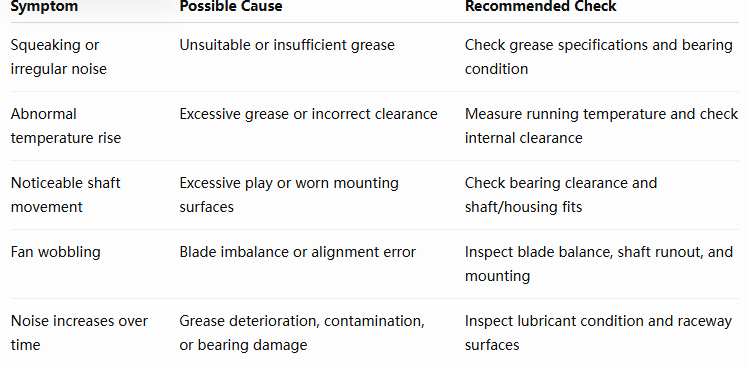
A useful diagnostic method is to compare bearings from the same production specification under identical operating conditions.
If bearings using different approved grease formulations demonstrate significantly different noise or temperature results, lubrication may be a contributing factor.
However, if wobbling remains unchanged, engineers should focus on the fan's mechanical assembly and balancing.
4. How to Choose 6201ZZ and 6202ZZ Bearings for Ceiling Fan Motors
For OEM buyers and ceiling fan manufacturers, selecting bearings by dimensions and price alone is not enough.
Before purchasing, confirm the following specifications:
Grease Selection: Choose a formulation suitable for the motor's actual temperature, speed, load, and expected service life.
Internal Clearance: CN and C3 provide different internal clearance ranges. The correct choice depends on interference fits, operating temperature, and motor design. C3 is not automatically better for every fan motor.
Noise and Vibration Requirements: Specify measurable acceptance criteria and a consistent testing method rather than relying only on general descriptions such as "low noise."
Bearing Consistency: Compare sample bearings with mass-production bearings to confirm stable dimensions, grease filling, and operating performance.
Assembly Compatibility: Verify shaft tolerance, housing fit, and installation method before confirming the final bearing configuration.
5. LUMI Bearing: Supporting Reliable Ceiling Fan Motor Performance
At LUMI Bearing, we understand that a bearing must do more than fit the motor. It must also deliver consistent performance under actual operating conditions.
We supply 6201ZZ, 6202ZZ, and other deep groove ball bearings for motor and industrial applications, with attention to:
• Suitable grease selection
• Controlled internal clearance
• Noise and vibration inspection
• Stable quality between samples and bulk production
• OEM bearing specification support
Experiencing unusual noise or vibration with 6201ZZ or 6202ZZ bearings?
Share your motor speed, operating temperature, bearing clearance requirement, and application details with our team.
We can help evaluate suitable bearing configurations for your next production order.
Comment