
How to Select Bearings for FPV and Drone Motors
Nov 11,2026 | Lumi Manufacturering Technology
The correct bearing for an FPV or drone motor is selected from the motor drawing and operating conditions—not from the motor size label alone. Start with the shaft and housing dimensions, then check speed range, combined loads, temperature, contamination, lubrication, fits and the validation plan. A model that fits physically is only a candidate until it is tested in the actual motor assembly.
Information to collect before selecting a bearing
| Input | Why it matters | Useful evidence |
|---|---|---|
| Shaft diameter, housing bore and available width | Defines the dimensional candidates and possible mounting arrangement | Motor drawing and measured mating parts |
| Normal, peak and transient speed | Affects lubricant, closure design, heat generation and validation duration | Motor/ESC test profile rather than KV alone |
| Radial and axial loads | Influences bearing arrangement and required capacity | Rotor mass, propeller thrust, shaft layout and shock events |
| Shaft and housing fits | Interference can reduce internal clearance; a loose fit can permit creep or movement | Tolerance drawing and measured production parts |
| Temperature and environment | Changes operating clearance and influences grease and protection choices | Ambient range, motor temperature and exposure to dust or moisture |
| Noise and vibration limits | Determines what must be measured and compared during approval | Baseline motor, measurement method and acceptance criteria |
A practical selection process
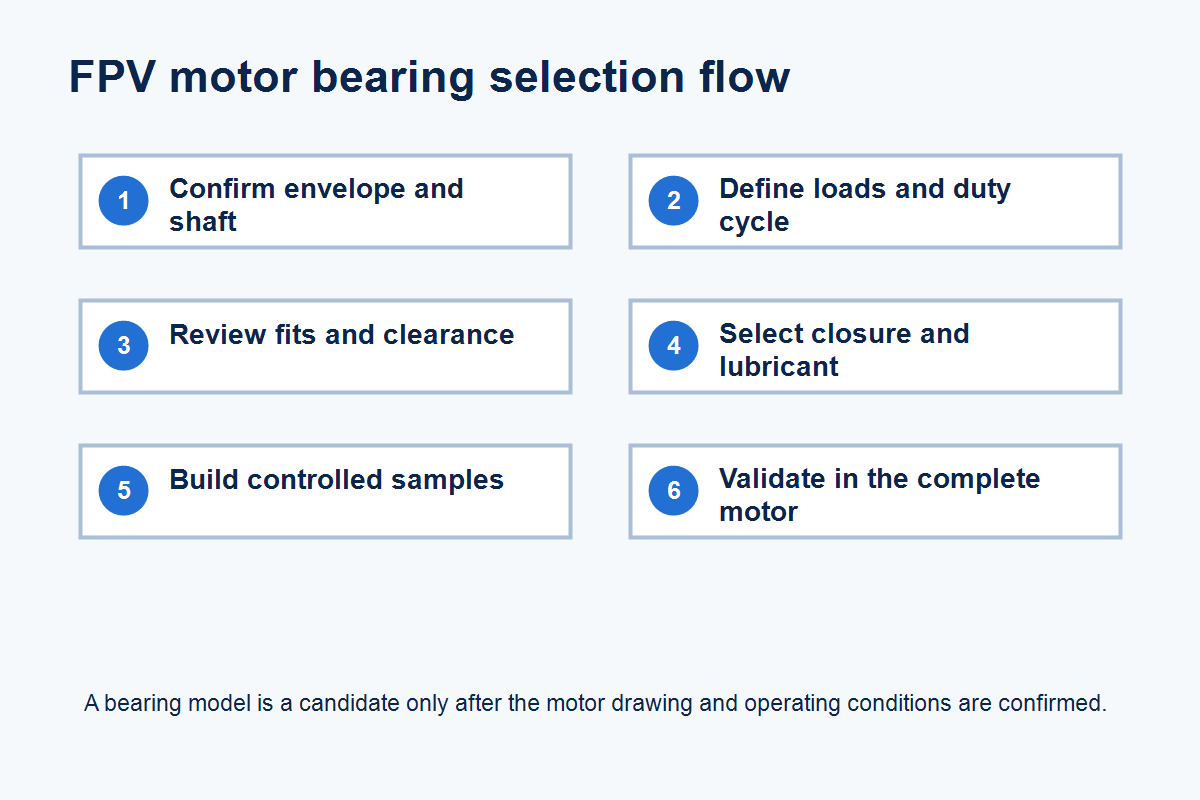
- Define the bearing position. Propulsion motors, gimbals and folding mechanisms have different loads, motion and contamination. This guide focuses on miniature deep-groove ball bearings in brushless propulsion motors.
- Confirm the dimensional envelope. Match bore, outside diameter and width to the drawing. Do not infer a bearing from labels such as 2207 or 3115; those labels do not uniquely define the shaft, housing or bearing arrangement.
- Describe the complete duty cycle. Record normal speed, peak speed, acceleration, run time, starts and stops, propeller loading and cooling. A no-load bench run is not equivalent to an installed flight condition.
- Review loads and arrangement. Consider radial load, axial thrust, shock and how two bearings locate the shaft. Bearing spacing, shoulders and any preload mechanism affect the result.
- Check fits and operating clearance. Initial clearance, shaft/housing interference and temperature differences combine to determine clearance during operation. C3 is not a universal high-speed solution; it should be discussed only after the fits and thermal condition are known.
- Select the closure and lubricant together. Metal shields, contact seals and confirmed non-contact seal designs provide different balances of protection and running resistance. Grease type and fill also affect torque, noise and heat.
- Set measurable acceptance criteria. Define the dimensions, running condition, temperature measurement point, noise/vibration method and comparison baseline before samples arrive.
- Validate samples in the motor. Use the same installation method and test profile intended for production. Record results and review any change before approving the specification.
Candidate sizes are not universal recommendations
LUMI's verified metric miniature range includes models such as MR106ZZ (6 × 10 × 3 mm), MR126ZZ (6 × 12 × 4 mm), MR148ZZ (8 × 14 × 4 mm) and 685ZZ (5 × 11 × 5 mm). These dimensions can help narrow a search, but none of these models should be treated as a default for all drone motors. The correct choice depends on the actual drawing, fits, loads, speed, environment and test result.
What to send for a useful bearing discussion
- Current bearing model or required bore × outside diameter × width
- Motor drawing or the shaft and housing tolerances
- Normal and peak operating conditions, including test duration
- Known radial/axial load information and bearing arrangement
- Ambient exposure, target temperature, noise or vibration requirements
- Preferred shield/seal, grease or clearance—if already specified
- Planned sample quantity and how the motor will be evaluated
How LUMI can support evaluation
LUMI can review the supplied conditions, discuss candidate dimensions and available clearance, grease and shield/seal configurations, and prepare samples for customer assembly validation. Depending on the confirmed project specification, dimensional, noise and vibration checks can be discussed, with available records, summaries, grading results or photos agreed for the project. Final motor suitability remains subject to validation in the customer's assembly and duty cycle.
See LUMI's Drone and FPV motor bearing support, review the metric miniature bearing range, or read how to validate bearing samples before mass production.
Technical references
General selection boundaries are based on SKF guidance for bearing execution, fits and operating clearance; NTN guidance for mounting and damage prevention; and NMB guidance for handling miniature bearings. Project-specific limits must be confirmed for the selected LUMI specification.
Candidate screening versus motor approval
A bearing candidate can pass a drawing review and still fail in the assembled motor. Use the first stage to eliminate incompatible dimensions and configurations; use the second stage to confirm the complete system.
| Decision stage | Evidence needed | Decision owner |
|---|---|---|
| Candidate screening | Drawing, bore × outside diameter × width, closure, lubricant and clearance discussion, stated operating conditions | Supplier and customer engineering discussion |
| Sample acceptance | Confirmed sample ID, dimensional or applicable inspection record, assembly method and baseline comparison | Customer project team with supplier support |
| Motor approval | Representative speed, load, duty cycle, temperature, noise and vibration results in the complete motor | Customer design and validation team |
For a structured sourcing path, review LUMI OEM miniature bearing solutions and the available inspection and quality-verification support.
Commentaire


