RC Car Servo vs. High-Speed Motor Bearings: Why One Bearing Setup Doesn't Fit Both
Oct 10,2026 | Lumi Manufacturering Technology
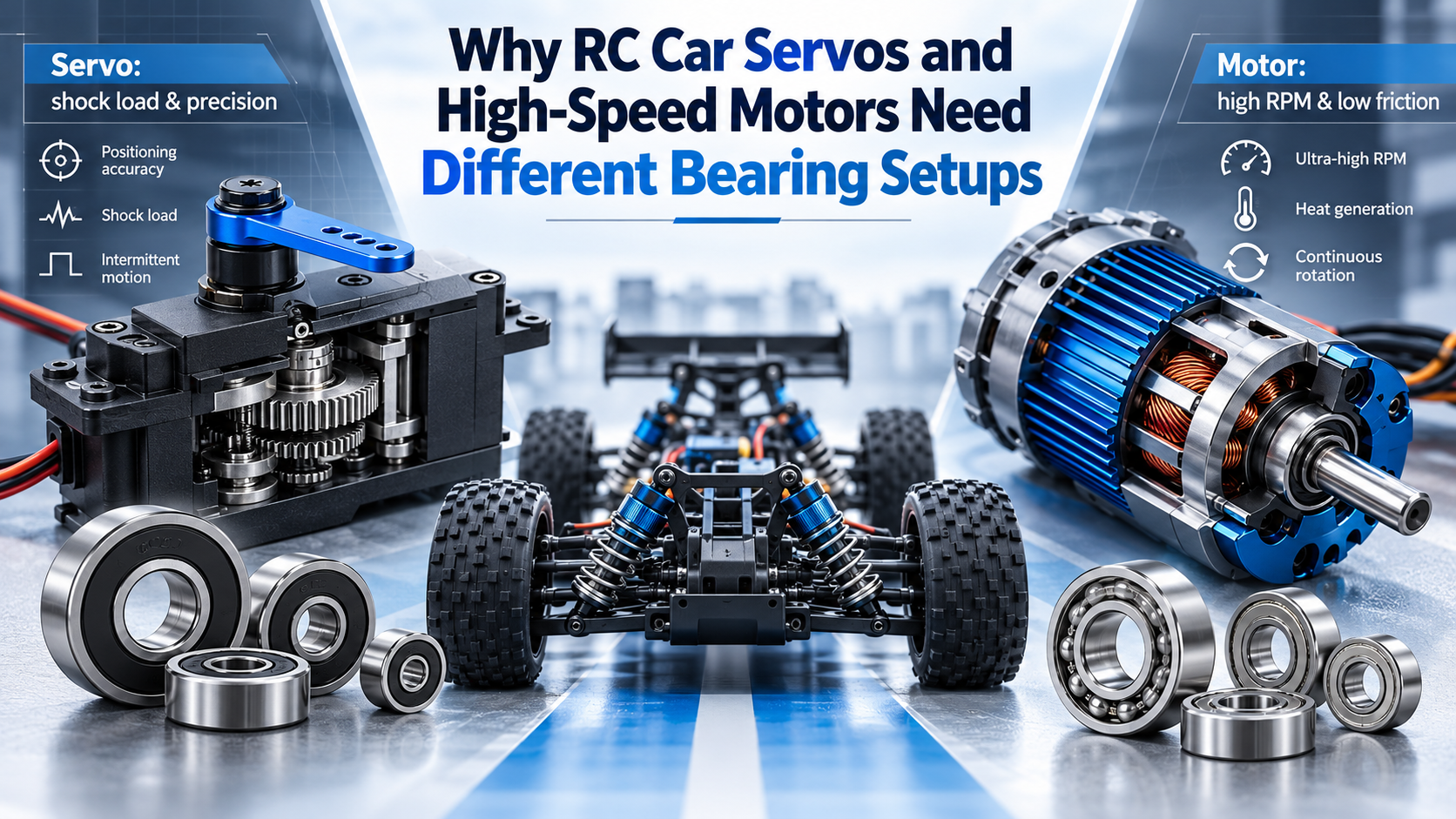
RC cars rely on both steering servos and high-speed brushless motors. Although both systems use bearings, their operating conditions are fundamentally different. Choosing identical bearing configurations can compromise precision, efficiency, and service life.
1. Different Operating Conditions Require Different Bearings
RC Steering Servos: High Torque and Repeated Direction Changes
Steering servos operate through repeated angular movements rather than continuous high-speed rotation.
For example, the Savox SV-1272SG+ servo delivers 35 kg·cm torque at 7.4V, with a positioning speed of 0.10 seconds per 60°.
Its output-shaft bearings must withstand changing radial loads, frequent direction reversals, and steering impacts.
Selection priorities include:
• High rigidity and suitable internal clearance
• Strong load resistance and reliable shaft support
• Low friction for accurate positioning
• Effective protection against dust and moisture
RC Brushless Motors: High RPM and Continuous Rotation
Brushless motor bearings face different challenges: sustained high-speed rotation, temperature rise, vibration, and lubrication stability.
The Hobbywing EZRUN 3652SD-5400KV G3 operates on a 2S LiPo battery.
At 7.4V nominal voltage, its theoretical no-load speed is approximately 39,960 RPM, calculated from its 5400KV rating.
Motor bearing selection should prioritize:
• High-speed grease and controlled friction
• Suitable clearance at operating temperature
• Low vibration and precise raceway geometry
• Sealing or shielding matched to contamination and speed
2. Real-World Product Comparison
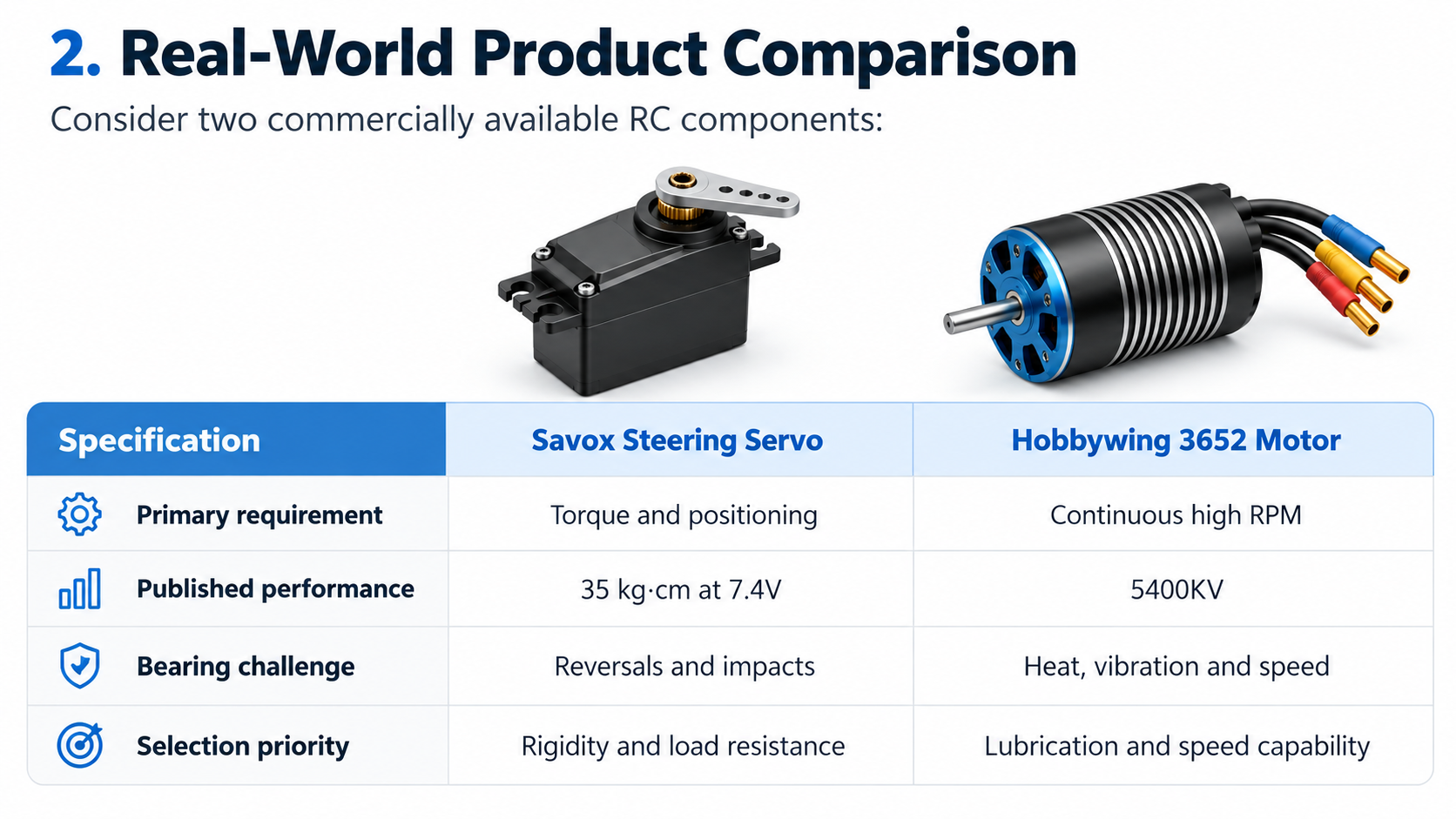
Hobbywing specifies different bearing dimensions within the same motor: 5 × 13 × 4 mm at the front and 5 × 11 × 5 mm at the rear.
This demonstrates why bearing specifications must follow actual mechanical requirements rather than a universal configuration.
3. What Should OEM Buyers Check?
Before purchasing RC bearings, confirm shaft dimensions, working speed, load direction, operating temperature, clearance, lubricant, and sealing requirements.
According to SKF's bearing-life calculation, doubling the equivalent load can reduce the calculated basic rating life of a ball bearing to one-eighth, assuming other conditions remain unchanged.
At LUMI Bearing, we help RC manufacturers select miniature bearings based on their actual operating conditions.
Looking for reliable RC servo or brushless motor bearings?
Contact LUMI Bearing for OEM bearing selection, samples, and quotations.
コメントを投稿