
Shielded vs Sealed Bearings for FPV Motors
Sep 02,2026 | Lumi Manufacturering Technology
For an FPV motor, a shielded or sealed bearing should be chosen by balancing contamination protection against running resistance and heat—not by assuming that ZZ is always faster or that every 2RS bearing is unsuitable. Shield and seal geometry, contact condition, material, grease, speed and the motor's environment all affect the result.
What the common closure terms mean
| Configuration | Typical function | FPV motor questions |
|---|---|---|
| Open | No integral shield or seal; depends on external protection and lubrication arrangement | Is the motor interior clean and protected? How will lubricant be retained? |
| Metal shield (often Z or ZZ) | Helps retain grease and exclude larger particles with a small running gap | Is the contamination level compatible with the gap? Is lower running resistance important? |
| Contact seal (often RS or 2RS) | The sealing lip contacts a ring to improve exclusion | Can the motor accept the added seal torque and resulting heat under its duty cycle? |
| Confirmed non-contact or low-contact seal | Design-dependent compromise between protection and torque | What exact seal code and geometry are available for this size? Has it been tested in the motor? |
Designation conventions vary by manufacturer. Confirm the drawing and specification instead of relying on the suffix alone.
When a metal shield may be a useful candidate
A shielded bearing can be considered when the motor has its own environmental protection, contamination is limited and running torque is tightly controlled. The gap at the inner ring means a shield is not a watertight barrier. Fine dust, liquid and cleaning fluid can still reach the interior under some conditions.
Shielded bearings are therefore not automatically the correct choice for every racing motor. Outdoor exposure, crash debris and the motor's airflow path must be considered.
When a seal may be worth evaluating
A contact seal can provide stronger exclusion where dust or moisture exposure is more important, but lip contact can add torque and heat. That trade-off must be checked at the motor's normal and peak speeds. Seal material, lip geometry and lubricant compatibility also matter; two products carrying a 2RS-style suffix may not behave identically.
If a non-contact or low-contact seal is proposed, confirm that the design is actually available in the required miniature size and obtain the supplier's specification. Do not describe a seal as non-contact merely from its color or catalog photo.
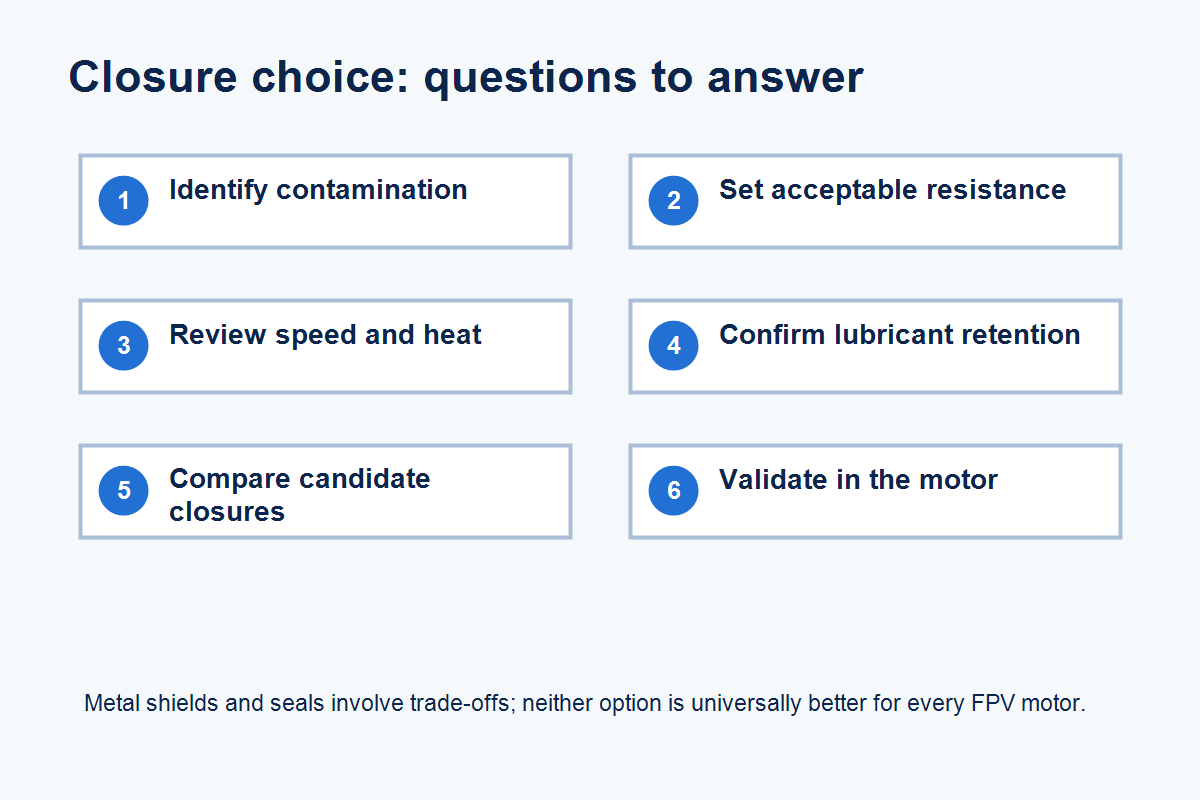
Five questions for choosing a closure
- What enters the motor? Identify dust size, grass, sand, moisture, cleaning chemicals and any pressure or airflow path.
- What resistance can the motor tolerate? Compare running current, coast-down behavior and temperature under the same installation and duty cycle.
- How is grease retained? Confirm grease type, fill and whether the closure is part of the retention strategy.
- What are the mating protections? Motor caps, labyrinth features and shaft interfaces can change the contamination risk.
- How will samples be compared? Test candidate closures in matched motors using the same parts, assembly force, load and temperature measurement points.
Comparison plan for an OEM sample test
- Keep bearing size, internal clearance and grease specification controlled unless one of them is the variable being tested.
- Record bearing suffix and the supplier's actual closure description.
- Measure motor current and temperature using a consistent test profile.
- Record noise and vibration using the same fixture, sensor position and background conditions.
- After environmental exposure, inspect for contamination, corrosion indicators and changes in running behavior.
- Do not approve a configuration from a single no-load run if production use includes propeller load, repeated acceleration or outdoor contamination.
Technical boundary
A closure can reduce contamination risk, but it does not make a miniature bearing waterproof or guarantee a service life. The result depends on the complete motor design, assembly, lubricant and duty cycle. A change from ZZ to 2RS—or the reverse—should be treated as a specification change and validated before mass production.
LUMI can discuss available shield/seal, grease and clearance configurations after the motor size and conditions are known. Samples can be prepared for customer assembly validation. For related context, see the Drone and FPV motor bearing page, the guide to selecting a motor bearing, and LUMI's inspection and quality verification capabilities.
Technical references
Closure principles and limitations are based on SKF guidance on shields, contact seals and torque, plus NMB guidance on contamination and miniature-bearing handling. The exact behavior of a proposed LUMI configuration must be verified from its specification and motor test.
For a verified size example, review the 685ZZ 5 × 11 × 5 mm bearing page. Its suitability for any FPV motor still depends on the motor drawing, fits, speed, loads, temperature and lubrication.
The suffix is not a complete closure specification
Do not approve a closure only from a suffix such as ZZ or 2RS. Suffix meanings and seal designs can vary by manufacturer and series. Before sample release, confirm the supplier drawing or specification for the exact bearing.
| Confirm | Why it matters in a motor |
|---|---|
| Closure on one or both sides | Affects contamination paths and whether the configuration matches the assembly. |
| Shield or seal geometry and contact condition | Influences protection and running resistance; the suffix alone may not describe contact. |
| Material and temperature compatibility | Must suit the actual environment and lubricant. |
| Lubricant type and fill discussion | Can influence start-up torque, heat, noise and service behavior. |
| Operating clearance after fits | Closure choice cannot compensate for clearance lost through shaft, housing or temperature effects. |
Record the approved closure and lubricant with the sample ID. LUMI can discuss candidate configurations through its OEM bearing selection support; final suitability remains subject to motor-level validation.
Kommentar


